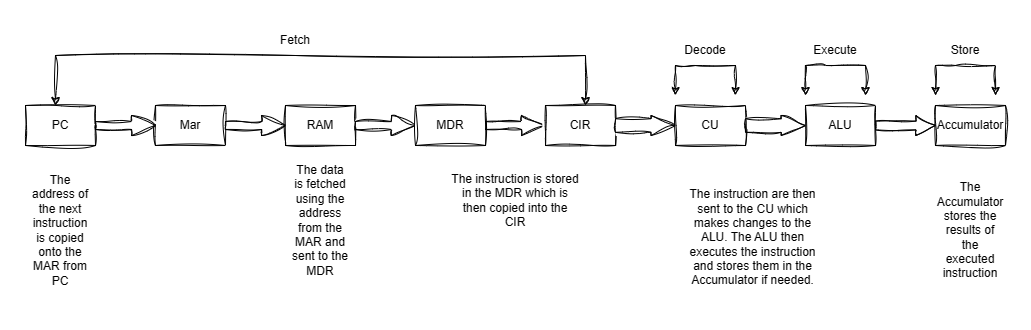
Fetch-Execute Cycle:
The Fetch-Execute Cycle, also known as the Instruction Cycle, it is the basic operational process of a computer. It is the process by which a computer retrieves a program instruction from its memory, determines what actions the instruction requires, and carries out those actions. This cycle is repeated continuously by the central processing unit (CPU), from bootup to when the computer is shut down.
Here is a brief explanation of the components involved and their roles:
Arithmetic Logic Unit (ALU):
This is where the actual computations and logical operations are carried out. It performs arithmetic operations like addition, subtraction, multiplication, and division. It also performs logical operations like AND, OR, NOT, etc.
Control Unit (CU):
This component controls the operation of the CPU and hence the computer. It directs the flow of data between the CPU and the other devices.
Clock:
The clock ensures that all operations in the CPU happen in sync. Each tick of the clock represents a single unit of time during which an action can be carried out. The speed of the clock (measured in Hertz) dictates how many instructions per second the CPU can execute.
Registers:
These are small storage areas in the CPU. They hold data that are being processed, the next instruction to be executed, or the address of the next instruction.
The Fetch-Execute Cycle involves the following steps:
- Fetch:
- Decode:
- Execute:
- Store:
The Program Counter is incremented to the next instruction’s address, and the cycle begins again.
This cycle continues until the program is completed or an error occurs. The speed of this cycle is determined by the clock speed of the CPU. The faster the clock, the more instructions can be executed per second. However, other factors such as data transfer rates and the complexity of the instructions also play a role in the overall performance of the CPU.